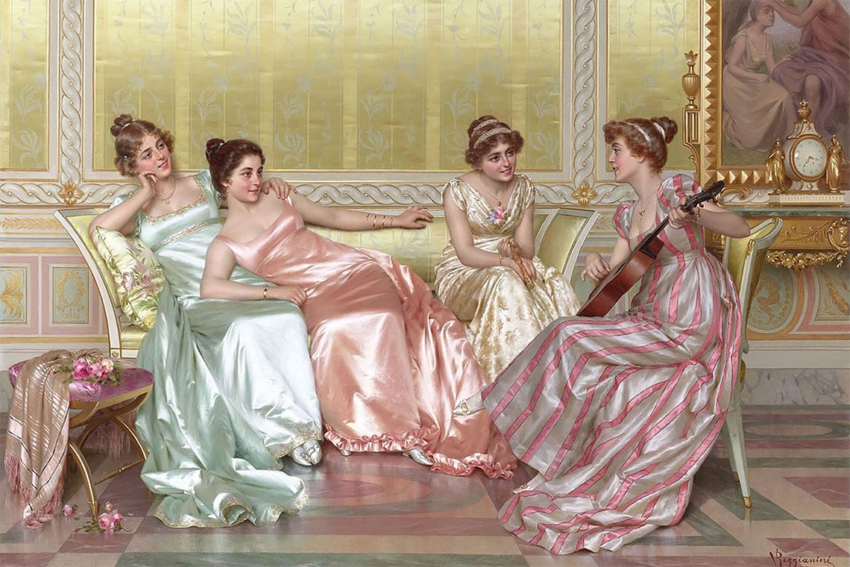
“Soft feminine”, “divine feminine”, “wife material”, “beauty with brains”: every one of these is a patriarchal, capitalist term.
Let’s start with what they mean.
Soft Feminine: a woman whose manner is gentle and calm
Divine Feminine: a woman who understands her femininity, confidence, and intuition, and knows how to use them
Wife Material: a woman the average man considers fit for marriage
Beauty with Brains: a woman who is both beautiful and intelligent
At first glance, they seem harmless enough. But look past the surface, and what do these terms actually amount to?
All women are women, and womanhood comes in countless forms. So why must a woman go out of her way to become soft and divine? And at what point does that need arise? Why is a world that has always dismissed women’s “softness” as weakness now telling them to be soft again?
Tell me, have you ever come across a single conversation about divine or soft femininity that doesn’t have marriage or a male partner at its centre? Fine, you’re soft and divine. But for whom? Soft and divine femininity are, in truth, modern tools for keeping the Madonna-whore narrative alive. (The Madonna-whore complex holds that a woman is either good and pure, or nothing more than an object of sexual desire.)
Needless to say, these terms exist to train women to become even more of a “wife”. A woman becomes a wife the moment she marries, and a mother the moment she has a child. So why the need to learn all these behaviours on top of that? Because women are waking up. They’re learning to question marriage and romantic relationships. If you don’t teach today’s girls, and young women who’ve only just come of age, to glamorise domestic life and motherhood, you’ll face a shortage of mothers and homemakers in the future. And even if you don’t, you certainly won’t find women who can be exploited in the name of marriage and children. They’ll have their own money and their own power. You won’t be able to make them slave away for the family, sacrificing their own lives in the process.
This is another major reason women are taught to romanticise marriage at a young age. After marriage and children, most women don’t think about their careers as seriously as a single woman does, nor do they have the time or opportunity to. So they never get the chance to build any financial footing of their own. As a result, women who marry young remain dependent on their husbands’ money for life. Then, if the husband divorces them or something happens to him, they’re left in the lurch. All the more so because parents rarely want to take in a divorced daughter.
And by the time a divorce comes round, these women have grown so detached from their own lives and careers that starting afresh becomes a battle. Where would she even work? Everywhere you look, it’s youth and early bloomers (people who achieve a great deal at a young age) being celebrated. As an older woman, she’s intimidated by the very thought of stepping into those spaces.
So it turns out that unquestioning dependence on a husband doesn’t bring women much freedom after all. You might say plenty of girls are clever about it: they get flats registered in their own names, they have gold made for themselves. No doubt. But I’m talking about empowerment, the kind that only becomes possible when a woman does something for herself, and that brings some balance to the power structure between women and men. A world where a woman is a person before she’s anyone’s mother or wife, where her identity rests on her own work, her own name, and her own power. Where she needn’t rely on her husband’s money because she already has plenty of her own before marriage. Where family and children are just one part of her life.
So what do these words, “soft” and “divine”, really do? I’d like to dig a little deeper into what they take part in and what they don’t. Read the subtext, and you’ll find they essentially describe a state free from “resistance”. Both terms sit at a level of peace and security where there’s no longer any need to resist anything at all.
But peace and security don’t have a collective face, and they aren’t available to everyone in equal measure. If that’s the case, how can so many women all be the same kind of “soft” and “divine” at once?
This is where the capitalist face of it shows. Soft and divine feminine women wear “elegant” clothes and accessories (there’s a great deal to say about words like that, but for the sake of this discussion I’ll leave that critique aside). Put simply, there are no unnecessary layers in how they dress. They speak slowly (which I’ve no problem with; it’s a good skill, but we’re discussing a type here), and there’s never any haste or hurry in the way they carry themselves. They have wealthy spouses, since I’ve yet to see an example of one paying her own way, and their lifestyle is very expensive. They fulfil the “soft” quota of the relationship by bearing and raising children, by keeping themselves worthy of a rich husband and his wealth, and by keeping the household in order (whether they do it themselves or leave it to the house help).
My question is this: haven’t women been doing the same thing for centuries in ordinary patriarchal societies? Why should the same work suddenly become special just because it’s been labelled divine feminine?
Then there’s the question of class. It goes without saying that low-income women are disqualified from the divine and soft quota from the outset. Besides, our habits and behaviour are shaped by the reality we grow up in. Say you grew up in a household where your father beat your mother every day. As a daughter of that household, when you grow up, marry, and move into your own home, how exactly will you be a divine feminine? What would that even mean? Will you first come to terms with the cruelty and inhumanity of your father beating your mother, and then become soft and divine? When you grow up as a woman in a misogynistic society, while your friend’s husband is beating her too, how does your soft and divine state make room for any of that?
This leads me to another question: if a feminist buys into the idea of divine and soft femininity, is that choice a feminist one?
This is precisely why I find tradwife content, and content where girls barely out of their teens romanticise motherhood and domestic life, harmful to young women. It sells them a dystopian dream. Reality is always political, and before they’ve even grasped that, they’re taught to aspire to become a man’s ideal wife and give birth to a beautiful baby. What a woman does with her own life is entirely her business. But the content being made for women tells us a great deal about the state of gender politics at any given time.
Life after childbirth isn’t the same for women and men. Men still don’t raise children for several reasons, one being that they’re the family’s main breadwinners. So when a man who neither carries nor raises children asks why a woman doesn’t want any, he’s either heartless or remarkably foolish.
Childbirth changes a person’s body in many ways, some of them permanent. A child is a round-the-clock responsibility until it’s old enough to fend for itself. Women have sacrificed their careers and their own lives to that responsibility for generations. So hasn’t this always been women’s lot? If a woman chooses it of her own accord today, why should that make it a particularly feminist choice?
Consider this: right now, plenty of girls from desperately poor families have to marry at… say 19. If one of them is happy in her marriage, does that do anything for other women? Or say a woman manages to marry into a very wealthy family. What good does that bring to the women of her society?
It seems that whatever else is said, it all comes down to the same thing: marry girls off young. And every woman’s reality is arranged so that she learns to romanticise domestic life from her teens; not a career, not her own wealth.
Meanwhile, women marrying later in life isn’t even allowed into the conversation. Where’s the content about a woman who married at 37 and is perfectly happy? Women choosing to stay single is one thing, and that’s there, of course, but why is society so reluctant to discuss women being able to marry later?
And in a society where purity culture (whether a girl is a virgin or not) runs as deep as it does, whom does this romanticisation of early marriage, motherhood, and domestic life really serve, and what does it actually mean?
I’d also like to ask how divine and soft femininity views other women’s sexual freedom, their choice never to marry, or not to have children. If we can answer that, we’ll know whether the women who subscribe to these ideas believe in the freedom of all women at all. Because the terms urging women to be softer and more divine never answer these questions.
I wrote about the problem with “beauty with brains” a long while ago, by the way.
I want to be clear that I didn’t write this to look down on women who practise soft and divine femininity. My writing is for everyone, women and men alike, and its purpose is to raise questions. To encourage you to at least keep the habit of turning the coin over and looking at every side.
If ideologies like soft and divine femininity appeal to you, I’d ask you to consider one thing. When you promote the idea that these special qualities of yours mean you deserve a better life and a wealthy partner, isn’t your message also saying that women without these qualities don’t deserve a comfortable life?
And in that case, aren’t you helping to keep patriarchy’s age-old weapon alive: the politics of sorting women into good and bad, pure and witch, Madonna and whore?
(written on March 17, 2027)
Completely agree. This is so true!