Disclaimer: this is rather a dissection of a cultural symptom, one you and I are going to do together to see what’s in it. Most importantly, we’re learning how to read between the lines, because nothing we see online, especially from magazines, is a matter of charity; it’s business. And we’re not here to remain simpletons who just let the media dictate how we read a text and move on. We’ll be discussing a lot of things, staying respectful to the individuals mentioned in this article. If you have anything to add, do let me know in the comments
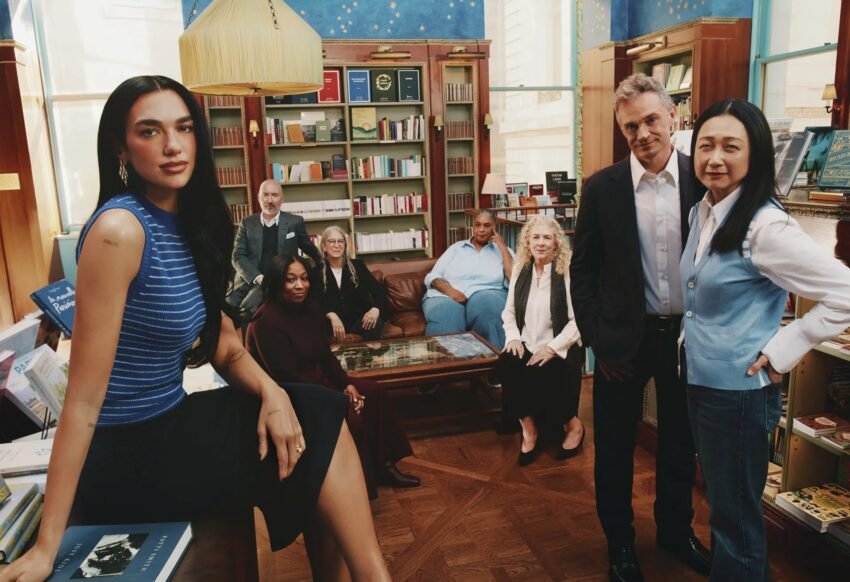
I’ve been looking at this photo since yesterday with my brows slightly knitted. It was posted by one of the authors I’m most excited to read next, Min Jin Lee, and the source is Vanity Fair. When you really look at it, you see where Literature is actually going in the age of social media, where everyone and everything is seen as equal on the ground level and judged only by the metrics of how well your content has performed in numbers, when glamour is taking centre stage in every corner of culture. Which is rather concerning. This tendency makes even something like the ‘Literary Crisis’ a less important discussion, once you realise it isn’t about a single photo but a recurring, large-scale pattern in how Literature is treated altogether.
I want you to look at the two different titles Vanity Fair used for these photos. On Instagram: “Getting Lit With Dua Lipa and Her Favourite Authors”; on their website: “Get Lit With Dua Lipa: For the Pop Star, Books Offer Radical Optimism. Here, She Meets Up With Some Favorite Authors.” Every single writer in that room has an identity of their own. I know it would be clunky to read if they listed every author’s name in the title, but being reduced to Dua Lipa’s ‘Favourite Authors’ doesn’t sound terribly respectful towards the writers, does it?
Mind you, she isn’t simply name-dropping authors she has read; she has Gathered them, physically, in the same room, thanks to the access and power her pop career has given her. Let’s change the scenario for a second, and you’ll see how absurd it sounds: Haruki Murakami and His Favourite Pop Stars: Murakami perched cross-legged on a table, closest to the lens, while Taylor Swift, Beyoncé, BTS, Billie Eilish and Bad Bunny sit blurry in the background, half of them cropped into the next slide, all in the middle of their own world tours. You’d immediately think, haven’t these people got careers of their own, to be reduced to props for Murakami’s promotion?
You would, but with authors, you’d think it’s fine seeing them next to Dua Lipa. Why? The problem lies in how we are all happy and okay with the layout.
“The Vanity Fair team masterfully managed to crown Dua Lipa and make a joke out of her at the same time.”
Now, visuals matter a great deal, don’t they? And working together, a magazine like Vanity Fair and a Pop Star and her team like Dua Lipa’s know it a hundred times better than you and I. When you’re presenting a group of Authors, Artists, Scientists and Creative minds in general, as a Host, even though you have the power to gather under one roof all the writers you want, what message does it send when the host sits literally perched higher than everyone else, the only one with an unreadable expression, and placed closest to the lens, while the authors exist as a background?
The star holds the absolute power in this photo. When there are literally people next to you who have “Published” books, and you’re the host or chair of the arrangement, why do you look like a group leader in the photo, like you’re doing them a favour? What favour? Is it letting them secure a seat in a room with you? A much bigger achievement, perhaps, than publishing a book? Why do you even sit like a pop star when you’re trying to become an authoritative literary figure while doing nothing literary or creative yourself? Is it creative work to gather writers when you have power? Would I be doing something scientific if I invited Einstein to my podcast? Or would I be doing something for science?
Your answer should be (with all due respect) the latter. So what Dua is doing isn’t creative, but she is doing it to ultimately shine a light on authors (we’re assuming for now that the whole thing is for the welfare of literature) and help them reach a broader readership. And they’re her… guests? Are we supposed to appear superior to our guests because we invited them? Then why do the visuals make it look like she is?
And how does the visual speak to you when you keep the fondness of her aside and realise the photo was taken that way: a choice was made in the process of direction, so you have to shift your eyes from her to the half of the subjects seated in the background to recognise, in the first place, who they are?
What made it worse, and made it impossible to look away from the odd message the photo was already sending, is what Vanity Fair chose as the caption.
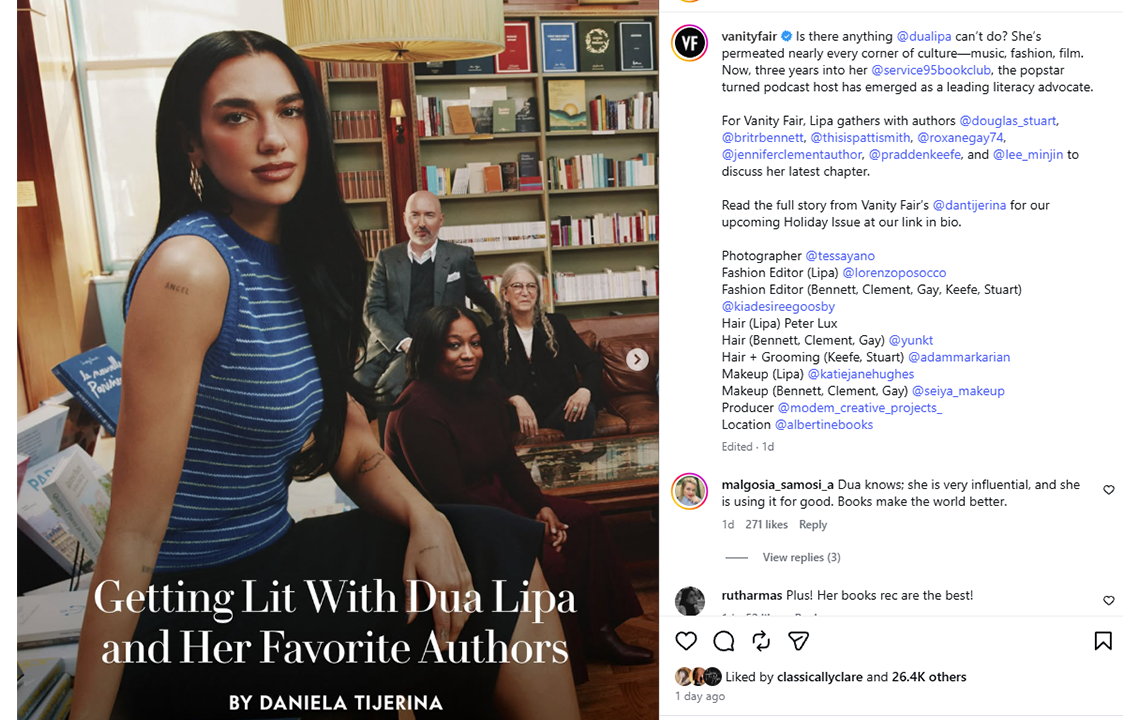
So it is about Dua Lipa. The writers were gathered for a purpose, which is not really… the literature they’re used to (come on, I don’t mind that it is). My objection is the way they used these writers and made them fade into the background, when some of them are literally in the middle of promoting their new books, in the middle of being the hero whenever they appear on your screen. Taking them from that and placing them next to a pop star to beautify her image was a rather showbiz move to make.
The PR team of Dua Lipa should’ve realised you cannot create a single format to promote every type of work that you do, or you risk looking as though you don’t know how to visibly respect creatives. I think they’ve presented Dua Lipa, a celebrated pop star, in a humiliating way. She’d still have shone on her own without being placed on a table like that.
In the first photo, or the cover Vanity Fair posted on Instagram, we see a cropped image: Dua up close, and far in the background sit four writers, slightly blurry. It isn’t even an image of all the writers she had gathered for the project or discussion. Were they so insignificant that they didn’t deserve (a word I’m deeply critical of, but we have to move on with it for now) to be on the cover? Blaming the image’s ratio here for not fitting them all would be a weak excuse when the Star herself takes up half the space. The author Min Jin Lee, who is having quite a moment right now, whose intellectual takes on many, many important issues I see and admire, who takes up space in an interview without even trying to, got cropped out of the photo and sits in the second one like an extension of the slide.
Interviewing or communicating with authors is no more creative work than writing a whole book, so why take a pose like that while the others settle for the second slide or the background? Honestly, I got second-hand embarrassment from seeing her like this. You’re not losing your spot if you let people have theirs for once.
The title itself made me laugh: “Get Lit With Dua Lipa: For the Pop Star, Books Offer Radical Optimism. Here, She Meets Up With Some Favorite Authors.” ‘Meeting up with some favourite authors’ doesn’t give the authors the respect they deserve. On top of that, they decided to pair it with that caption, which is all vanity, no fairness. In the end, the Vanity Fair team masterfully managed to crown Dua Lipa and make a joke out of her at the same time.
Also, if Dua Lipa is giving them a stage, they’re the ones helping her most to intellectualise her brand, to become the authority that the magazines and her fans claim she is. The help is reciprocal, isn’t it? So where’s a sign of that reciprocity? The acknowledgement, the gratefulness to show that she is indeed dependent on them? That the writers are in no way inferior to a superstar’s glory?
So, when you look at this picture, it’s not much different from how she’d stand in front of her backing dancers on stage. Sometimes you’re simply the host, leading a cultural trend and giving the stage to the people who actually belong under the lights. I’m glad, at least, that I didn’t have to see Ishiguro in this photo, a man whose entire body of work is built on restraint and dignity. Imagine him placed beside a pop star like a prop; that would have been unbearable.
“As an authority, your job is far bigger than mothering other readers: it’s to find and champion new authors.”
I wish this photo had some harmony: a pop star willing to be a humble host, and the authors holding the reins, as confident as the star looks. Just a bit more authority from the authors would have gone a long way, a bit of balance in the visual power, you know. These writers are definitely bigger than Dua Lipa’s literary image and book club. Aren’t they?
With all due respect to Dua Lipa, I’ve followed her music since she was just starting. It was never quite my taste, but I’ve always regarded her as brilliant and brave, from the way she writes her lyrics to the way she carries herself. And I think what she is doing is already very important. I do wish she had more faith in that, enough to get down off the table and stand or perhaps sit with the authors. She gets books into people’s hands, introduces authors to a broader audience, a brilliant and timely thing to do. Which is exactly why the framing matters so much.
One small suggestion I’d make to Dua, as a well-wisher: she and her team have somehow got the Pop Star Professionalism and the Intellectual Professionalism mixed up. I’ve noticed she usually switches between being a star and turning the authors into her Pals. There’s nothing wrong with being pals with them. But if you’re launching something, it’s better not to choose either of these; instead, you can simply be a host, and maybe not make it too casual, like they’re your pals, at least when the camera is on. The language around her intellectual branding needs a bit more Professionalism, not the Pop Star kind but the intellectual kind. And being a literary authority doesn’t mean you become the mother of your fellow readers, that you’re “happy that people are reading”. People have been reading, just like you. I’m sure other readers are glad you’re reading too, but as an authority, your job is far bigger than mothering them: it’s to find and champion new authors for them, with the access and power that only you hold. You already do this to a great extent; perhaps have a little more confidence in it.
The way writers are being used as props for a pop star instead of having a well-deserved stage of their own tells you a lot about how, in this age, literature only sells once you add glamour to it. As someone who has been writing for over 11 years and hopes to get published one day, I still don’t have an answer to what would be the proper, dignified way to be celebrated as an author without turning into a celebrity or being made a prop by celebrity magazines, which I find to be a vital question for any author. But I’ll be looking for it.
Also, I’ll be curious to see what Dua Lipa, someone passionate about literature, does about the wrong message Vanity Fair sent about her.